
Licensed General Contractor · Licensed New Home Builder in MD · 20+ Years DC, Maryland & Virginia Construction Experience
You found the lot. It's in the right school district. The neighborhood feels perfect. The listing says "value is in the land." Your mind is already placing furniture in a house that doesn't exist yet.
Stop. Before you call your agent, before you schedule a walkthrough, before you start pinning kitchen islands on Pinterest — you need to answer one question:
Can you actually build what you want on this lot?
Not "is this lot buildable in theory." Not "does it have a house on it now, so obviously you can build one." The question is whether your home — the size, shape, and configuration you're envisioning — can legally, physically, and financially be built on this specific piece of dirt.
After 300+ residential projects across Bethesda, Potomac, Chevy Chase, Kensington, and the broader DC suburbs, I can tell you: the answer is not always yes. And the families who find out after closing are the ones who pay the most painful tuition in real estate.
This is the complete guide to evaluating lot buildability before you buy. Every constraint, every red flag, every number you need to check — from someone who's run these analyses hundreds of times.
The 8 Things That Determine Whether You Can Build on a Lot
Lot buildability isn't one question — it's eight. Miss any one of them and you're looking at a project that's either significantly constrained, dramatically more expensive, or dead on arrival.
1. Zoning Classification
Zoning is the foundation of everything. It determines what you can build, how big it can be, and where on the lot it can sit. In Montgomery County, most residential lots fall into R-60, R-90, R-200, or RE-1 zones — each with different minimum lot sizes, setback requirements, and density limits.
An R-60 zone requires a minimum 6,000-square-foot lot. R-200 requires 20,000 square feet. RE-1 requires a full acre. If your lot doesn't meet the minimum for its zone, you may not be able to build at all — or you may need a variance, which is a bureaucratic adventure that costs $5,000–$15,000 in legal fees and takes 6–12 months with no guarantee of approval.
How to check: Montgomery County's MC Atlas (atlas.mcgov.org) shows zoning for every parcel. Or use LotIQ for an instant analysis that includes zoning plus setbacks, buildability, and constraints. For a DMV-wide overview of how setbacks, lot coverage, FAR, and height limits shape what you can actually build, see our companion guide on Zoning Regulations in the DMV.
2. Setback Requirements
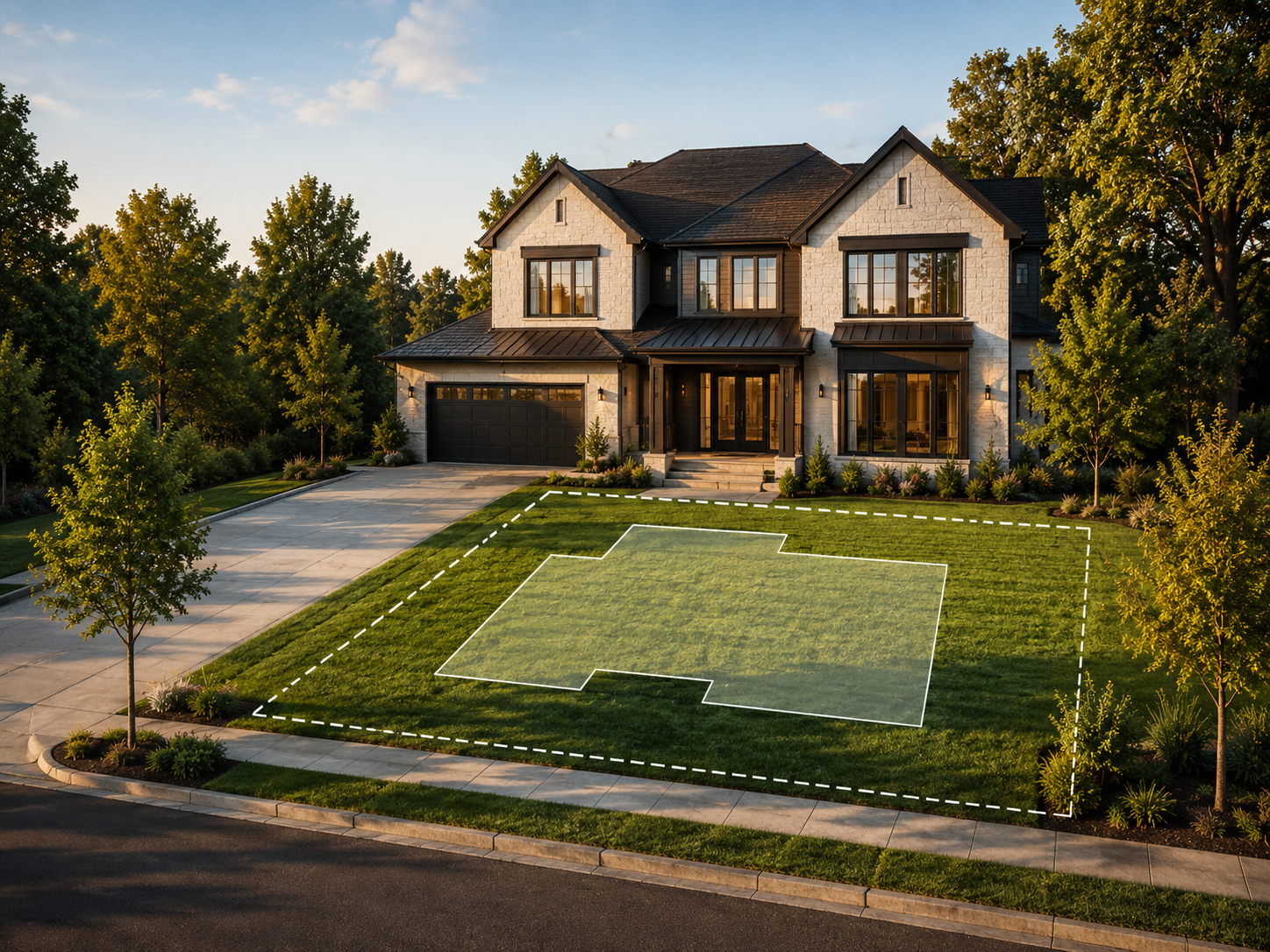
Setbacks define how far your house must be from each property line — front, rear, and both sides. They're set by your zoning classification and they're non-negotiable (without a variance). The space between the setback lines is your building envelope — the actual area where your house can sit.
Here's where dreams meet geometry. A 12,000-square-foot lot sounds generous. But after you subtract a 25-foot front setback, a 20-foot rear setback, and two 8-foot side setbacks, your building envelope might be 6,400 square feet. That supports roughly a 3,200-square-foot footprint — which means if you want 5,000 square feet of living space, you're going up (multiple stories) or going down (finished basement).
The math that matters: Lot width minus both side setbacks = maximum building width. Lot depth minus front and rear setbacks = maximum building depth. Multiply those two numbers — that's your maximum footprint. Everything else flows from there.
Older homes in the DC suburbs were often built under different setback rules. The existing house may sit closer to a property line than current code allows. That doesn't mean your new home can do the same. You're building under today's rules, not 1957's. For the full breakdown of combined side setbacks, front setback averaging, and the traps that catch most architects, see our detailed guide to setback requirements and calculations .
For a deep dive into how setbacks, building coverage, and height limits interact to determine the actual square footage you can build, see our complete guide to calculating maximum home size .
3. Floor Area Ratio (FAR)
FAR caps the total above-grade floor area relative to lot size. In most Montgomery County residential zones, FAR effectively limits you to about 30–35% of your lot area in above-grade living space. On a 10,000-square-foot lot, that's roughly 3,000–3,500 square feet above grade.
The good news: basements typically don't count toward FAR. So if you need 5,000 square feet of finished space, you build 3,200 above grade and finish 1,800 in the basement. This is why virtually every custom home in the DC suburbs has a finished basement — it's not a luxury, it's a zoning strategy.
The move: Calculate the maximum allowable above-grade square footage before you ever talk to an architect. The lot dictates the house, not the other way around. For a detailed breakdown of what that house costs once you know the size, see our complete 2026 custom home cost guide .
4. Building Coverage and Impervious Surface Limits
These are two separate calculations, and both must pass independently. Building coverage is the building footprint as a percentage of lot area. Impervious surface coverage includes everything that doesn't absorb water: the house, driveway, sidewalks, patios, pool decks, and any other non-permeable surface.
You can be well within building coverage limits and still blow impervious surface limits the moment you add a circular driveway, a paver patio, and a pool surround. This is the constraint that kills outdoor living plans more than any other.
The workaround: Permeable pavers, green roofs, and stormwater management systems can help — but they add cost and complexity. Budget $15,000–$40,000 for stormwater solutions if you're pushing impervious surface limits.
5. Flood Zones and Stream Buffers
FEMA flood maps define 100-year and 500-year floodplains. If any portion of your lot falls within a Special Flood Hazard Area (SFHA), you're dealing with a different universe of regulations: mandatory flood insurance, elevated foundation requirements, restrictions on what can be built below the base flood elevation, and potentially significant additional engineering costs.
Stream buffers are equally important. Montgomery County requires setbacks from streams and wetlands that can dramatically reduce your buildable area. A lot that looks like a quarter acre on paper might have an effective buildable area half that size once you subtract the stream buffer.
How to check: FEMA's flood map service (msc.fema.gov) shows flood zone designations. But don't rely on maps alone — a surveyor can tell you exactly where the floodplain boundary falls on your specific lot.
6. Soil Conditions and Topography
A flat lot with good soil is a gift. A sloped lot with clay, rock, or a high water table is an engineering challenge — and engineering challenges have price tags attached.
- Slope: Lots with more than 15% grade may require retaining walls, special foundation designs, and more complex grading plans. Each of these adds $20,000–$80,000+ to your project.
- Soil type: Expansive clay soils (common in parts of Montgomery County) require deeper footings and may crack conventional foundations. Rocky soil requires excavation equipment that costs 3–5x more than standard digging.
- Water table: A high water table means waterproofing costs increase and you may need a permanent sump system. In extreme cases, a finished basement becomes impractical.
The move: A geotechnical report ($3,000–$8,000) tells you everything about soil conditions. Get one during due diligence, not after closing. The teardown lot guide covers this and other due diligence steps in detail.
7. Utility Access and Capacity
Most lots in the established DC suburbs have water, sewer, gas, and electric service. But "has service" and "has adequate service for the home you want to build" are different statements.
- Water/sewer: Upsizing from a 3-bedroom rancher to a 6-bedroom custom home may require a larger water meter and upgraded sewer lateral. WSSC (Washington Suburban Sanitary Commission) handles this, and their review process takes 4–12 weeks with its own fee schedule.
- Electric: If the existing service is 100-amp and you need 400-amp for your dream kitchen, EV chargers, and HVAC system, the electrical upgrade and transformer work can cost $15,000–$30,000.
- Gas: Most urban/suburban lots have gas service. Some larger lots in Potomac or outer Bethesda may be on propane — converting to natural gas (if available) adds cost and timeline.
For a complete breakdown of the permitting process including WSSC , see our Montgomery County permits guide. For a deeper dive specifically on water, sewer, electric, gas, easements, and 811 requirements, see utility access before building a custom home.
8. Trees, Forest Conservation, and Environmental Constraints
The DC suburbs take their trees seriously. Montgomery County's forest conservation law is among the strictest in the region. If your lot has significant tree canopy — and many teardown lots in Bethesda, Potomac, and Chevy Chase do — you may be required to preserve certain trees, submit a forest conservation plan, and post bonds for trees that will be impacted.
A single "specimen tree" (typically 30+ inches in diameter) in the wrong location can force you to redesign your entire floor plan. Tree preservation requirements can shrink your building envelope, dictate your driveway placement, and add $10,000–$50,000 in mitigation costs.
The move: Walk the lot with an arborist before you make an offer. Identify every tree over 24 inches in diameter and note its location relative to your likely building envelope. This 30-minute walkthrough can save you $100,000 in redesign costs.
The 5-Minute Lot Evaluation: Your Pre-Offer Checklist
You don't need a full feasibility study before deciding whether a lot is worth pursuing. You need a quick screening to separate the contenders from the pretenders. Here's what you can check in five minutes from your laptop:
- Zoning classification — MC Atlas or LotIQ. Does the zone allow what you want to build?
- Lot dimensions — Tax records or SDAT. Calculate approximate building envelope using setbacks for that zone.
- Flood zone status — FEMA flood map service. Is any portion in a Special Flood Hazard Area?
- Tree canopy — Google Earth satellite view. Heavy canopy = potential conservation requirements.
- Topography — Google Earth terrain view. Significant slope = additional engineering costs.
- Comparable sales — What have recent teardown lots sold for in this immediate area?
If the lot passes this five-minute screening, it's worth the deeper dive: a boundary survey, geotechnical report, and formal buildability analysis. If it fails on zoning or flood zone, you've saved yourself weeks of wasted time and thousands in due diligence costs.
What a Professional Buildability Analysis Actually Covers
Once a lot passes initial screening, you need professional eyes on it. A full buildability analysis — whether from a builder, architect, or construction consultant — should answer these questions definitively:
- What is the maximum buildable footprint after all setbacks?
- What is the maximum above-grade square footage under FAR?
- What are the impervious surface limits, and how much outdoor hardscape can you add?
- Are there any environmental constraints (flood, stream buffer, forest conservation)?
- What are the utility upgrade requirements and estimated costs?
- What will demolition, site clearing, and grading cost on this specific lot?
- What is the realistic total project budget for the home you want to build here?
A full feasibility study from an architect or land use attorney runs $5,000–$15,000. A preliminary assessment from an experienced builder or construction consultant runs $1,000–$3,000. For a free initial screening, LotIQ provides instant analysis of zoning, setbacks, buildability, and risk factors.
Real-World Examples: Lots That Looked Great on Paper
The Bethesda Lot with the Hidden Easement
Beautiful half-acre lot in a prime Whitman district location. Listed at $1.1M. The buyers ran the basic checks — zoning was R-60, lot was oversized, no flood zone. Everything looked perfect. What they missed: a 15-foot utility easement running diagonally across the rear third of the lot, not visible on standard zoning maps but recorded in the deed. That easement shrank the building envelope by 30% and made their planned pool impossible. They closed anyway and built a smaller home than planned.
Lesson: Always pull the deed and plat. Easements don't show up on zoning maps.
The Potomac Lot with the Stream Buffer
An acre lot in Churchill district. Listed at $1.3M. Gorgeous mature trees. A small stream ran along the back property line — "charming," according to the listing agent. That charming stream triggered a 100-foot environmental buffer from each bank, consuming nearly 40% of the lot's usable area. The buyers could still build, but their 6,000-square-foot dream home became a 4,200-square-foot reality. They also spent $35,000 on stormwater management that wouldn't have been required on a lot without the stream.
The Kensington Lot That Was Actually Two Lots
A family bought what they thought was a 15,000-square-foot lot for a custom build. During the survey, they discovered the property was actually two separately platted lots of 7,500 square feet each. In their R-60 zone, that was fine — both lots met the 6,000-square-foot minimum. But the combined setbacks for two lots versus one changed the building envelope calculation entirely. They ended up subdividing, building on one lot, and selling the other — which actually worked out well financially. But it wasn't the project they planned.
The Cost of Not Checking
Here's the math that makes lot buildability analysis non-optional:
- Cost of a boundary survey: $1,500–$3,000
- Cost of a geotechnical report: $3,000–$8,000
- Cost of a professional feasibility analysis: $1,000–$3,000
- Cost of a free LotIQ screening: $0
- Total pre-purchase due diligence: $5,500–$14,000
Now compare that to what it costs when you don't check:
- Redesigning a home after discovering setback constraints: $15,000–$40,000
- Engineering solutions for unexpected soil conditions: $20,000–$80,000
- Stormwater management for unanticipated impervious surface issues: $15,000–$40,000
- Variance application (if needed): $5,000–$15,000 in legal fees + 6–12 months delay
- Buying a lot you can't build on at all: The full purchase price — potentially $800K–$1.5M
The bottom line: $5,500–$14,000 in due diligence protects a $2M+ investment. That's less than 1% of the project budget. Skip it at your own risk.
How to Use This Information When Making an Offer
Lot buildability analysis isn't just about deciding whether to buy — it's about deciding what to pay. Every constraint you identify is a negotiation point:
- Significant tree conservation requirements? That's $20,000–$50,000 in mitigation costs. Adjust your offer accordingly.
- Sloped lot requiring retaining walls? That's $30,000–$80,000+ the flat-lot buyer next door won't spend. Price it in.
- Utility upgrades needed? WSSC and electrical work isn't cheap. Factor it into your total project budget.
- Stream buffer reducing buildable area? The lot is functionally smaller than its recorded size. Your offer should reflect the usable area, not the total area.
Armed with a proper buildability analysis, you're not guessing — you're negotiating with data. And in a market where teardown lots routinely trade above $1M, the difference between an informed offer and an emotional one can be $50,000–$150,000.
Frequently Asked Questions
How do I find out the zoning for a specific property in Montgomery County?
Three options. Montgomery County's MC Atlas (atlas.mcgov.org) is the official source — enter the address and look for the zoning layer. Maryland's SDAT database also shows zoning for most parcels. Or enter the address into LotIQ for an instant analysis that includes zoning plus setbacks, buildability, flood risk, and lot constraints.
What makes a lot unbuildable?
A lot may be technically unbuildable if it's too small for the minimum lot size in its zone, if setbacks leave insufficient buildable area, if it lacks legal access, if it's entirely within a floodplain or stream buffer, or if environmental contamination makes development impractical. Most lots in established suburban neighborhoods are technically buildable. The real question is whether they're buildable for the home you actually want to build.
How much does a professional lot buildability analysis cost?
A full feasibility study from an architect or land use attorney costs $5,000–$15,000. A preliminary assessment from a builder or consultant runs $1,000–$3,000. For a quick initial screening, LotIQ provides a free instant analysis of zoning, setbacks, buildability, and risk factors for Montgomery County properties.
Should I get a survey before buying a lot?
Yes. At minimum, a boundary survey ($1,500–$3,000) to confirm property lines. For new construction, you'll eventually need a full topographic survey as well. The boundary survey protects you from buying a lot whose actual dimensions differ from the recorded plat — this happens more often than you'd think, particularly with older properties where fence lines and property lines aren't the same thing.
What's the difference between building coverage and impervious surface coverage?
Building coverage is just the building footprint — the first-floor outline. Impervious surface coverage includes everything that doesn't absorb water: the house plus driveways, sidewalks, patios, pool decks, and any other non-permeable surface. You can be well within building coverage limits and still violate impervious surface limits. They're separate calculations, and both must pass independently.
Found a Lot? Let's Check What It Can Build.
Send us the address or MLS listing of any lot you're considering. We'll run a free buildability assessment within 48 hours — zoning, setbacks, building envelope, constraints, and estimated project costs. No pitch. Just the numbers you need to make an informed decision.
Request Your Free Lot Analysis →Vipin Motwani
Founder, Iron Gate Development